Projektabrechnung 101: Wie mache ich es richtig?
Ever quoted a project for 20 hours, only to discover three weeks later that the team has logged 60? You’re not alone – and it’s not because anyone did anything wrong.
Here’s what happens: Research takes longer than expected. Client feedback comes in waves, requiring multiple revision rounds. Those “quick sync calls” add up to hours of billable time that somehow never gets tracked.
The result? Invoicing customers in a way that don’t reflect the actual effort, profit margins that vanish, and that nagging feeling you’re leaving money on the table.
But here’s the good news: project billing doesn’t have to feel like guesswork.
Ready to stop undercharging and start running projects that actually make money? Let’s dive in.
Melde dich an und teste, wie die automatische Zeiterfassung deinen Abrechnungsprozess vereinfacht.
Die wichtigsten Erkenntnisse
- ⚡️ Smart project billing always starts before the first task with clear scope definition, rate setting, and choosing a billing method that protects your margins.
- 💰 Stop leaving money on the table – automatic time tracking is your backbone tool. It prevents revenue leakage and ensures you’re billing for those “quick” client calls and research sessions that add up fast.
- 🎯 Mix and match billing methods strategically – time and materials, fixed-cost, retainer billing, value-based, or milestone billing.
- 🚫 Kill scope creep before it kills profit – those “small tweaks” destroy margins. Set clear boundaries in contracts and implement a formal change request process.
- 📊 Ground your estimates in real data – historical project data turns guesswork into predictable profitability and prevents that sinking feeling when you realize you underquoted.
Check it out: What are billable hours?
Was ist die Projektabrechnung?
Project billing is the process of tracking and charging for all work and resources used in a project, then collecting payment from clients accordingly. Simple definition, complex execution.
Here’s what makes it tricky: project billing actually begins long before you complete a single deliverable. It starts during project planning, when you’re conceptualizing milestones, considering cash flow, and mapping out payment collection.
And here’s the reality nobody warns you about: project billing is impacted by factors often outside your control. Budget adherence, resource allocation, deadline management, external provider delays – they all cascade into your billing process and profitability.
But when done right? Project billing becomes your agency’s profit engine instead of its Achilles heel.
The stages of a project billing cycle
Project billing success starts before any actual work begins – it starts in the project planning phase. Let me walk you through each critical stage of a most common project billing cycle so you can protect your margins from day one.
Stage 1: Define the project scope, billing method, and rate
Profitability is often decided long before the real work begins – right here, at the planning stage. Getting clear on the project scope, billing approach, and pricing structure sets the foundation for every profitable project that follows.
1. Understand the project requirements
Before you think about pricing, make sure you know exactly what the client needs, and what could complicate the process.
Start with a detailed client questionnaire or discovery session. You’re not just clarifying deliverables, you’re identifying hidden challenges that could affect time, effort, or scope later.
Ask questions like:
- What’s the real deadline pressure?
- Who needs to approve deliverables (and how fast are they)?
- Are there dependencies on client-provided materials?
- What’s the revision expectation?
- Have they done a similar project before?
The more you understand upfront, the fewer surprises down the line.
2. Choose the right billing method
Once you’ve defined the scope, pick a billing model that fits the project type. Your choice determines how risk and flexibility are shared between you and the client.
Here’s a quick framework:
- Unclear scope? → Go with time-and-materials billing for flexibility.
- Crystal-clear deliverables? → Choose fixed-cost billing for predictability.
- Ongoing relationship? → Use retainer billing for financial stability.
- Can measure ROI directly? → Try value-based billing.
- Big project with distinct phases? → Opt for milestone-based billing.
3. Set rates that protect your margins
Pricing isn’t guesswork, it’s strategy. When setting your rate, look at both external benchmarks and internal data.
Key factors to consider:
- Project complexity and required expertise – specialized work deserves premium pricing.
- Market rates – know what competitors charge.
- Desired profit margin – build it into your calculation.
- Timeline and urgency – rush jobs cost more.
- Historical data – check how long similar projects actually took.
Once you combine this data with your professional judgment, including client history and relationship value – you’ll have a rate that’s competitive, sustainable, and profitable.
Stage 2: Create the contract and documentation
If you’ve been in business for a while, you’ve had disputes with clients. And you probably discovered that your contract was your only defense in those conflicts.
Make bulletproof contracts. Every contract should clearly outline:
- The chosen billing method and specific rates
- The payment schedule and payment terms (including late fees)
- The scope of work and exact deliverables
- Change request procedures (make this ironclad)
- Late payment policies
- Revision limits and what triggers additional charges
Pro tip from experience: Include specific examples of what constitutes billable work. This prevents 90% of future disputes. For instance, “Two rounds of revisions included. A revision round is defined as consolidated feedback addressing the entire deliverable. Line-by-line edits or content rewrites constitute additional scope.”
Pro tip: Interested in understanding the billing process in more detail? We’ve written a comprehensive article on client billing. Dive in to clarify all your questions.
Stage 3: Execute the project and track your work
This is where the rubber meets the road – and where most agencies start hemorrhaging money without realizing it.
Implement systematic tracking. Make sure to track:
- Hours worked by team members (automatically if possible)
- Resources used and additional expenses
- Milestone completion against schedule
- Progress against original estimates in real-time
Real talk: My team uses automatic time-tracking software where we categorize time by projects and tasks with tags. This helps us track new expenses and resources, making billing more accurate and transparent.
But here’s what changed everything: Switching from manual to automatic tracking. Manual time tracking fails because people forget, they estimate instead of logging actual time, and they feel guilty tracking “non-productive” time like research or admin work.
Stage 4: Create and submit invoices
Now it’s time for creating and sending invoices.
Generate detailed invoices:
- Base invoices on tracked resources and time spent
- Include all relevant project information and payment terms
- Attach supporting documentation (time reports, expense receipts)
- Use professional billing software that integrates with your time tracker
The key here is making invoices so detailed and well-documented that they’re essentially dispute-proof. When clients can see exactly where their money went, payment happens faster.
Stage 5: Collect payments and reconcile
Your accurate invoices should come to fruition – meaning you should actually get paid for your work.
Handle the payment process professionally:
- Track payment status in your system
- Send payment reminders if needed (automate this!)
- Process late fees if applicable per your contract terms
- Reconcile payments with invoices in your accounting system
- Document any payment discrepancies
Pro tip: Remember that a change request process should exist for any alterations to fixed-cost projects. There should be a standardized way to record, assess, and approve/reject changes. An efficient project cost-tracking system is the best way to protect the work done by the team.
Höre auf, deine abrechenbaren Stunden zu schätzen, und beginne, jede Minute zu erfassen, die wichtig ist. Erfasse deine Zeit genau, stelle sie sicher in Rechnung und steigere die Rentabilität deiner Projekte. Mit EARLY!
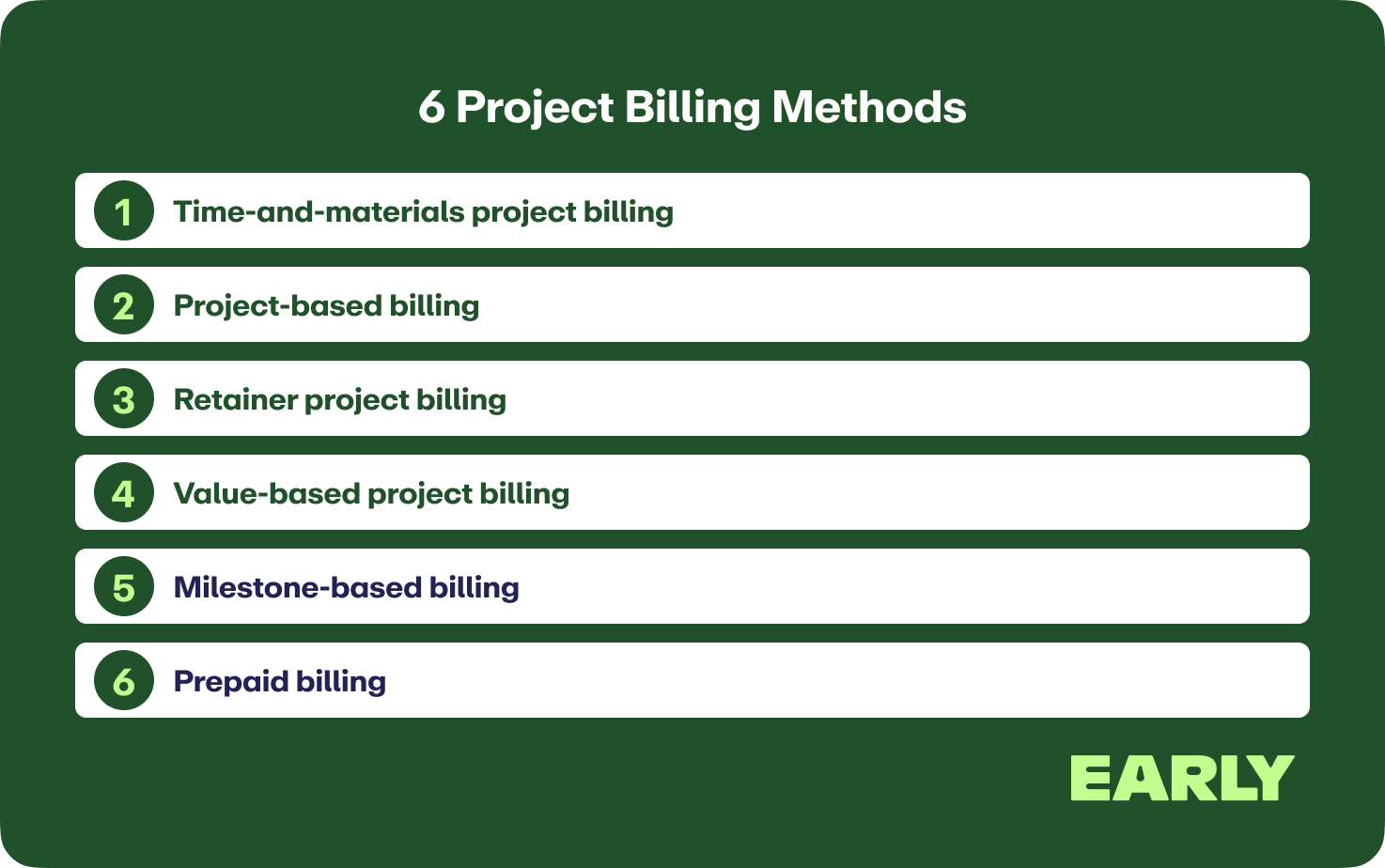
Die 6 Methoden der Kundenabrechnung (und wann sie sinnvoll sind)
The way you bill projects can make or break profitability. There are different types of billing, and choosing the right one depends on your industry, services provided, cash flow needs, and client relationships.
Let me break down various billing methods so you can choose strategically.
1. Time-and-materials project billing method
Clients pay for actual time spent on their project, plus any materials or resources used, based on predetermined rates.
Best suited for:
- Projects with unclear scope or variable requirements
- Development work with potential changes
- Creative work with multiple revision rounds
- Research-heavy projects
- When requirements often evolve throughout execution
How to apply it effectively:
- Track all hours spent on project tasks in your time-tracking system
- Add costs of all materials or resources used
- Apply agreed-upon hourly rates consistently
- Create invoices regularly based on project frequency (weekly, bi-weekly, or monthly)
- Share transparent time reports with clients
Advantages:
✅ Minimizes risk for service providers
✅ Complete transparency for clients
✅ Flexible for scope changes
✅ Fair compensation for extra work
✅ Rewards efficiency while protecting against complexity
Nachteile:
❌ Requires meticulous time tracking (nightmare without automation)
❌ Creates budget uncertainty for clients
❌ May incentivize slower work pace if you’re not protecting your reputation
❌ Needs strong client trust and communication
Pro tip: Set a “not-to-exceed” cap on T&M projects to give clients budget protection while you maintain flexibility. Best of both worlds.
2. Project-based billing
You set and agree on a price before the project begins, regardless of actual time spent or resources used during execution.
Best suited for:
- Projects with clearly defined scope and detailed requirements
- Repeatable services where you have extensive experience
- Short-term engagements with specific deliverables
- When clients need budget certainty
How to apply it effectively:
- Estimate total project costs upfront by breaking down all required tasks
- Calculate expected hours needed for each component
- Add a buffer of 15-20% for unexpected issues
- Include profit margin based on project complexity
- Create detailed scope documents outlining what IS and ISN’T included
- Set up a clear change request process for out-of-scope work
Advantages:
✅ Budget certainty for clients (easier project approval)
✅ Simplifies the billing process (no hourly tracking for invoices)
✅ Higher profit potential if you complete work efficiently
✅ Can handle multiple projects simultaneously
✅ Rewards your expertise and optimization
Nachteile:
❌ Risk of scope creep if deliverables aren’t clearly defined
❌ Requires detailed scope documentation upfront
❌ Potential loss if project is poorly estimated
❌ Less flexible for changes without renegotiating price
❌ You absorb all cost overruns
Pro tip: Even on fixed-price projects, track time internally. This data is gold for refining future estimates and identifying which project types are actually profitable.
3. Retainer project billing
Clients pay a fixed fee, usually every month, for a predetermined set of services or amount of work.
Recurring billing is best suited for:
- Services requiring ongoing support and consistency
- Marketing and content creation services
- Subscription services
- Maintenance and support projects
- Long-term client relationships
How to apply recurring billing effectively:
- Define clear monthly deliverables or available hours
- Establish processes for adjusting retainer scope when needed
- Set up regular check-ins to review project progress
- Create systems for tracking unused hours or extra work with overtime trackers
- Document what happens to unused retainer hours (roll over, lose them, or bank them)
Advantages:
✅ Predictable monthly income for service providers
✅ Predictable cash flow for planning
✅ Better resource allocation and planning
✅ Reduces time spent on proposals and contract negotiations
✅ Builds stronger long-term client relationships
Nachteile:
❌ Can be challenging to adjust scope or pricing once established
❌ May require regular justification of value
❌ Risk of scope creep without clear boundaries
❌ Requires consistently delivering quality
❌ Can feel like you’re “always on” for clients
Pro tip: Build flexibility into retainer agreements with quarterly review points. This lets you adjust deliverables or pricing as needs evolve without constant renegotiation.
4. Wertorientierte Projektabrechnung
You set project prices based on the value delivered to the client rather than time spent or resources used, typically tied to specific business outcomes or ROI.
Best suited for:
- Strategic consulting projects
- Marketing campaigns with measurable outcomes
- Performance improvement initiatives
- Business transformation projects
- When you can directly impact client revenue or savings
How to apply it effectively:
- Identify and quantify the specific value your work will deliver
- Create clear metrics for measuring success
- Establish pricing tiers based on different value levels
- Set up regular reporting on value delivered
- Document baseline metrics before starting work
Advantages:
✅ Potential for higher profits based on client success
✅ Better client satisfaction when value is achieved
✅ Focuses conversation on outcomes, not hours
✅ Rewards expertise and results
✅ Can dramatically outperform hourly billing
Nachteile:
❌ Can be challenging to quantify value upfront for certain deliverables
❌ Requires strong proof of previous results
❌ Higher risk if value metrics aren’t achieved
❌ Complex to explain to some clients
❌ May require longer sales cycles
Pro tip: Start with hybrid value-based pricing – a base fee plus a success bonus. This protects your downside while capturing upside when you deliver exceptional results.
💡 Recommended article: What is block billing?
5. Milestone billing
You break payment into predetermined project milestones, with specific amounts due upon completion of each phase.
Best suited for:
- Large, complex projects with distinct phases
- Software development projects
- Website design and development
- Long-term consulting engagements
How to apply it effectively:
- Break the project into clear, measurable milestones
- Assign specific payment amounts to each milestone
- Create detailed completion criteria for each phase
- Establish clear verification processes
- Tie milestones to client value delivery when possible
Advantages:
✅ Steady cash flow throughout the project
✅ Provides clear progress indicators
✅ Reduces client risk through phased delivery
✅ Makes it easier to manage scope within each milestone
✅ Natural checkpoints for client alignment
Nachteile:
❌ Can cause overdue payments if milestones slip
❌ Requires more complex project management
❌ Creates challenges with resource allocation
❌ Dependencies can cause payment delays
❌ Potential disputes over milestone completion criteria
Pro tip: Weight your milestone payments toward the front of the project (larger deposits) to reduce your financial risk and improve cash flow.
6. Prepaid billing
Clients pay upfront for a specific amount of work, service hours, or project credits. As work is completed, charges are deducted from the prepaid balance until it’s used up. Once the balance runs low, clients can top it up to continue services.
Best suited for:
- Consulting, design, or legal services with variable workloads
- Clients who prefer predictable budgeting without long-term commitments
- Projects with flexible timelines or scope
- Businesses wanting to secure payment before delivery
How to apply it effectively:
- Define the project scope and rate for prepaid hours or credits in the contract
- Use time tracking software like EARLY to record all the hours accurately
- Set up automatic alerts when balances run low
- Provide transparent usage reports so clients know how their balance is spent
- Offer the option to top up or renew easily to maintain workflow continuity
Advantages:
✅ Immediate payment improves cash flow and reduces payment risk
✅ Encourages clients to commit without long-term contracts
✅ Simplifies billing and reduces admin time
✅ Builds trust through transparent tracking and reporting
✅ Allows flexible work scheduling for both the service provider and the client
Disadvantages:
❌ Requires consistent time and expense tracking to ensure accurate billing
❌ May limit large, ongoing project commitments
❌ Risk of unused hours if clients delay projects
❌ Can strain relationships if balance runs out mid-project
❌ May need strong communication to manage expectations
Pro tip:
To make your prepaid billing system more efficient, offer tiered packages or discounted bundles (e.g., 10-, 25-, or 50-hour plans). This rewards clients for larger upfront payments and keeps your team’s workflow steady.
Types of billing: A quick comparison table
| Billing Type | How to Apply | Advantages | Disadvantages |
|---|---|---|---|
| ⏱️ Time and materials | • Document all resources and materials used • Diligently track time and materials spent • Apply agreed-upon hourly rates • Bill clients accurately based on project frequency | • Minimizes risk for service providers • Complete transparency for clients • Flexible for scope changes • Fair compensation for extra work | • Requires meticulous time tracking • Creates budget uncertainty for clients • May incentivize slower work pace |
| 💎 Fixed-cost | • Break down all tasks upfront • Add a 15-20% buffer for unexpected issues • Create detailed scope documentation • Set up a change request process | • Provides budget certainty • Simplifies the billing process • Higher profit potential with efficiency • Easier project approval | • Risk of scope creep • Potential loss if poorly estimated • Less flexible for changes • Requires extensive upfront planning |
| 🔄 Retainer billing | • Define clear monthly deliverables • Establish scope adjustment processes • Set up regular check-ins • Track unused hours/extra work | • Predictable recurring payments • Better resource planning • Reduced contract negotiations • Steady cash flow | • Hard to adjust scope/pricing • Need to justify value regularly • Risk of scope creep • Requires consistent quality |
| 💰 Value-based | • Identify & quantify deliverable value • Create clear success metrics • Establish value-based pricing tiers • Set up regular value reporting | • Higher profit potential • Better client satisfaction • Aligns with client success • Focus on results | • Hard to quantify value upfront • Requires proof of past results • Higher risks if goals missed • Complex to explain to clients |
| 🎯 Milestone-based | • Break the project into clear phases • Assign specific payments per milestone • Create detailed completion criteria • Establish verification processes | • Steady project cash flow • Clear progress indicators • Reduced client risk • Easier scope management | • Payment delays if milestones slip • Complex project management • Resource allocation challenges • Dependencies can cause delays |
- Empfohlener Artikel: Abrechenbarkeit vs. Auslastung
Project billing challenges (And how to solve them)
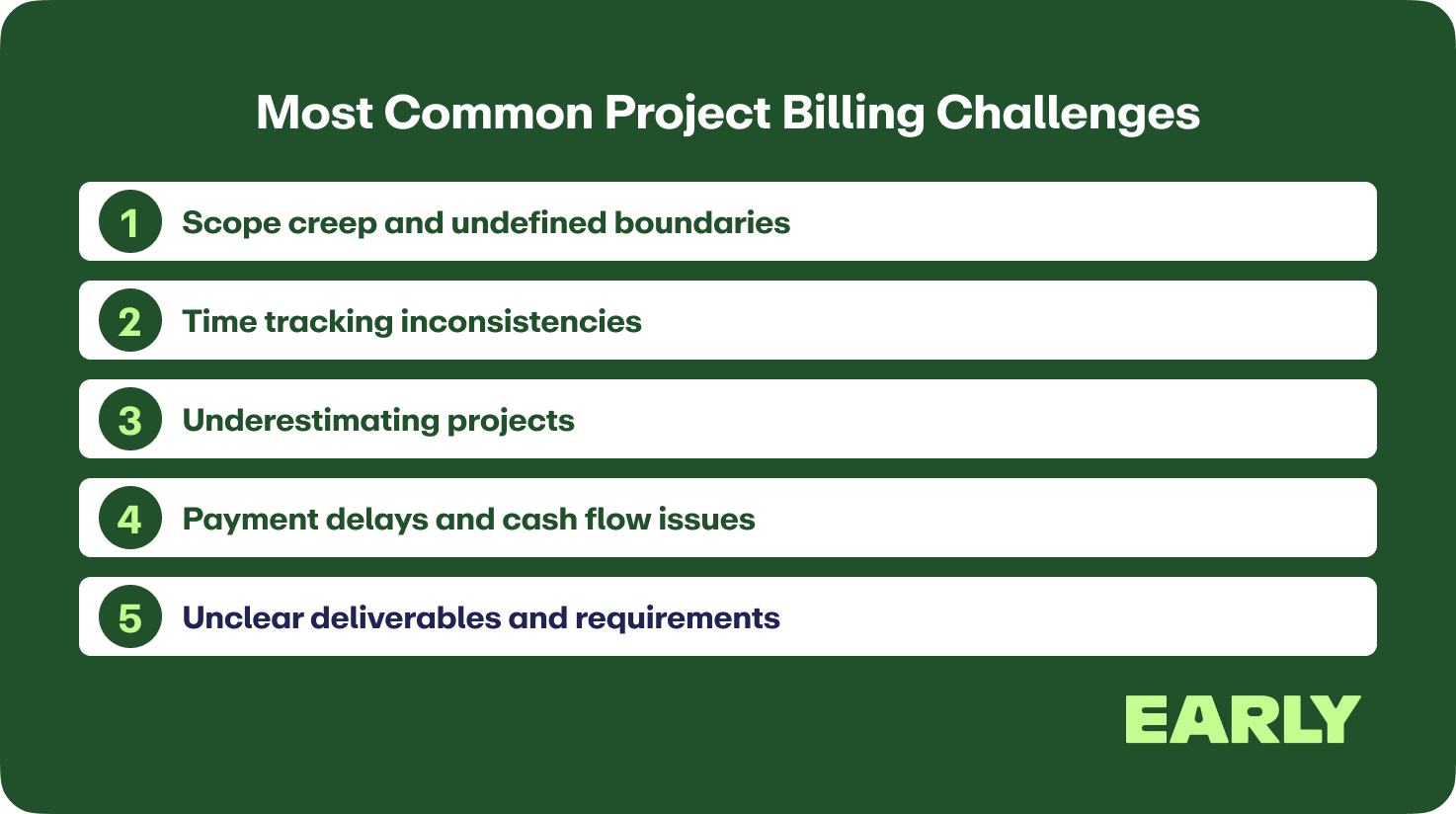
Challenge #1: Scope creep and undefined boundaries
The problem:
We’ve all been there – a client asks for “just a few quick tweaks,” and before you know it, those small changes have turned into days of extra work. What starts as a simple request can quietly derail timelines and eat into your profit.
The solution:
The best way to avoid scope creep is to set clear boundaries from the start and communicate them openly. Make sure your contract spells out how many revisions are included, what’s covered and what’s not, and how additional work will be billed. When new requests come in, pause and get written approval before moving forward.
💡 Tip: Use automatic time tracking as your documentation. When a client says “it was just small changes,” you can show the 17 hours spent on those “small” revisions. With EARLY’s automatic tracking, you’ll have precise records that make these conversations factual instead of emotional.
Challenge #2: Time tracking inconsistencies
The problem:
Without accurate time tracking, you risk undercharging or losing client trust with inflated hours. Projects often go unprofitable simply because team members forget to log research time, client calls, or small tasks that add up.
The solution:
Use an automatic time tracker to capture every minute of work without starting or stopping timers. It records both billable and non-billable hours, applies hourly rates automatically, and alerts you when you’re nearing time limits — ensuring consistent, transparent, and profitable time tracking.
- Recommended article: The difference between billable and actual hours
Challenge #3: Underestimating projects
The problem:
Projects often seem simple at first, but hidden complexities lead to overtime and shrinking margins. Underestimation happens when you rely on guesswork instead of data or overlook “invisible” tasks and client delays.
The solution:
Use real data to ground your estimates. With EARLY, you can track actual hours, analyze past projects, spot where work usually takes longer, and add realistic buffers. Reviewing similar projects before quoting and refining estimates regularly turns time tracking into a profitability shield — giving you accurate, data-backed projections that protect your margins.
Challenge #4: Payment delays and cash flow issues
The problem:
Few things disrupt a business more than late payments. With milestone-based billing, even one delayed approval can create a domino effect – stalling timelines, holding up new projects, and throwing off resource planning.
The solution:
Protect your cash flow by structuring payments strategically. Start with a deposit of 30–50% before work begins, and weight milestone payments toward the early phases so you’re never waiting too long to get paid.
For longer projects, consider progress billing or retainer billing to keep income steady. You can also shorten payment cycles by billing more frequently, setting tighter terms, and sending automated reminders.
Finally, mix different client billing methods – like combining quick-turnaround projects with retainer work – to balance your cash flow and reduce risk from overdue payments.
Challenge #5: Unclear deliverables and requirements
The problem:
When project requirements aren’t nailed down from the start, confusion creeps in fast. Suddenly, no one’s sure what’s included in the original project scope and what should be billed as extra – and that’s how billing disputes start.
The solution:
Clarity in the billing process begins with documentation. From day one, capture everything – use discovery questionnaires, summarize client calls, and get written approval on requirements. In your contract, spell out exactly what’s included, what’s not, and how many revisions are allowed. As the project moves forward, confirm any new requests in writing and keep a simple change log so everyone stays on the same page.
How to improve your project billing process
A smooth billing process starts with a strong foundation — clear systems, reliable tools, and consistent documentation.
Standardize and communicate in a clear way
Use templates for proposals, contracts, and invoices, and set regular check-ins to keep projects aligned. Keep asking yourself:
- Are your billing methods keeping you profitable?
- Is cash flow consistent?
- Which projects deliver the best margins?
Clarity and consistency prevent surprises – both for you as a service provider and for your clients.
Use the right tools
The right tools turn billing chaos into a streamlined system. Combine automatic time tracking with billing software to ensure every billable hour is captured and invoiced correctly.
- EARLY: Tracks time automatically and syncs with invoicing.
- QuickBooks / FreshBooks: Generate invoices, track payments, and centralize finances.
- Stripe / PayPal: Simplify payment collection and improve cash flow.
Turn every working minute into revenue with precision tracking. No more lost billable hours, no more revenue slipping through the cracks with EARLY.
Build a data bank
Each project gives you insights into what really drives profitability. After completion, compare estimated vs. actual hours, budget vs. cost, and margin by project type.
Use that data to refine estimates, price smarter, and identify where scope creep or delays tend to happen – turning every project into a learning loop that boosts future profitability.
Fazit
Look, project billing doesn’t have to be this fuzzy, stressful thing where you’re constantly wondering if you undercharged again.
Yes, it’s complex. Yes, there are a lot of moving parts. But with the right approach – clear scope definition, strategic billing method selection, bulletproof contracts, and automatic time tracking – it becomes your profit engine instead of your pain point.
FAQ
What’s the difference between project billing and hourly billing?
Project billing is based on a defined scope with predetermined pricing (fixed, milestone, or value-based), while hourly billing charges strictly by time worked. Project billing requires more upfront planning but can be more profitable since you’re paid for value and efficiency, not just hours.
Which project billing method is most profitable?
The most profitable project billing method depends on your project type and client preferences. Value-based billing often yields the highest profit when results can be measured clearly. Fixed fee or flat fee billing methods provide predictability and reward efficiency, especially when supported by historical data. Time-and-materials based billing is safer for projects with unclear scopes.
A successful billing process involves selecting the right billing schedule and method tailored to each project’s characteristics, aligning with client preferences, and supporting efficient business operations.
Should I track time even on fixed-price projects?
Absolutely. Tracking time internally, even when you don’t work based on hourly billing, is essential for maintaining an accurate billing system that aligns with your business model and complies with legal and regulatory requirements. It supports business growth by ensuring that your projects remain profitable.
What’s the best way to improve cash flow with project billing?
First of all, establish a well-structured billing schedule. Using retainers for ongoing clients can also provide predictable income. Implementing an integrated billing system helps streamline the billing process by enabling efficient payment tracking and management of outstanding invoices.
These strategies ensure timely payments, which are critical for effective cash flow management. Additionally, maintaining clear communication and transparency throughout the billing cycle enhances customer satisfaction, encouraging prompt payment and minimizing delays.
What is a project billing cycle?
A project billing cycle is the repeating process of tracking, invoicing, and collecting payment for client work. It directly affects your cash flow, project profitability, and billing accuracy.